
Frameless and semi-frameless glass pool fencing, designed and installed across Tauranga, Mount Maunganui and Papamoa. Fully compliant with Building Code clause F9, built from 12 mm toughened safety glass, and engineered for the salt air that destroys ordinary hardware.

A pool fence is a legal requirement. It does not have to be the thing you look at. Glass pool fencing gives you an unbroken view across the pool and the garden beyond, which is the reason most Bay of Plenty homeowners who can stretch to it never go back to panel fencing. It keeps sightlines to the water open, which matters for supervision as much as aesthetics, and it does not shade planting or catch wind the way a solid fence does.
TBGF has been designing, manufacturing and installing balustrades, gates and fencing across the Bay of Plenty since 2005. Glass pool fencing sits at the premium end of what we build, and it is the product where installation quality shows up most obviously. Panels that are a few millimetres out of plumb are visible from across the lawn.
The three glass systems differ in how the glass is held, and that drives both the look and the price.
Frameless is the premium option. Panels of 12 mm toughened glass are held by stainless spigots set into the deck or concrete, with no posts and no top rail. Visually it is the cleanest system available, and it is what most people picture when they think of glass pool fencing. Because there is no frame carrying the load, the glass itself is structural, so panel thickness, spigot spacing and the substrate all have to be right.
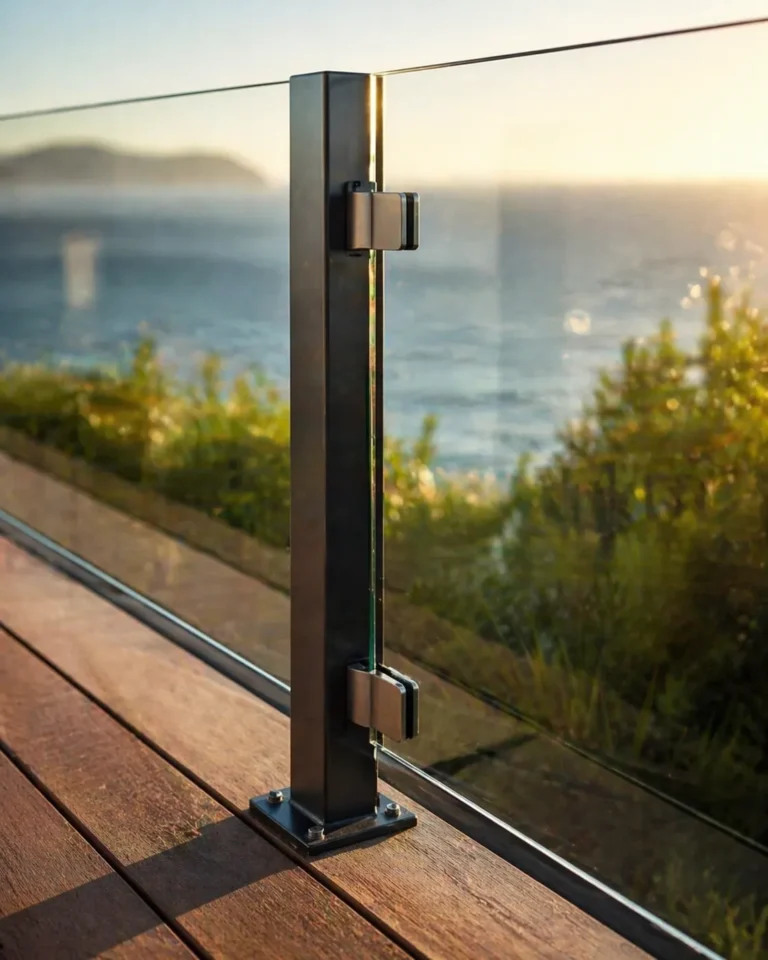
Semi-frameless uses slimline posts between the panels, usually aluminium or stainless, with no top rail. It costs less than frameless because thinner glass and wider panel spacing become possible once posts share the load. From a few metres away the difference is subtle, which makes it the value pick for long runs.
Framed systems surround each panel with an aluminium frame. It is the most economical glass option and the most robust in high-traffic or exposed positions, at the cost of the uninterrupted look. It suits properties where the fence line runs across uneven ground or where budget matters more than the view.
Every glass pool fence we install uses 12 mm toughened safety glass. Toughened glass is heat treated so that it is several times stronger than ordinary glass, and if it does ever fail it breaks into small blunt granules rather than shards. Anything thinner than 12 mm has no place in a frameless pool barrier.
There are two ways to fix frameless panels. Spigots are individual clamps bolted to the deck or core-drilled into concrete, and they are the more common choice for pool surrounds because they let you follow a slightly irregular pool edge. Channel fixing sets the glass into a continuous base channel, which gives an even cleaner line and is often used on balconies and terraces where the run is straight and the substrate is level. Both are compliant when specified and installed correctly. The substrate matters more than the hardware: spigots bolted into thin or poorly cured concrete are the most common cause of a glass fence that moves.

Glass does not exempt a pool fence from anything. Residential pool safety in New Zealand sits under the Building Act 2004 and Building Code clause F9, which replaced the Fencing of Swimming Pools Act 1987 on 1 January 2017. Every glass pool fence we build is designed to meet F9 and its acceptable solution F9/AS1.
In practice that means a barrier at least 1.2 metres high measured from the ground on the outside, no gap anywhere in or under the fence exceeding 100 mm, and no climbable elements within 1.2 metres of the outside face. The 100 mm rule is the one that catches poorly planned glass installations: the gap between panels, the gap under the bottom edge and the gap at a gate hinge all have to stay under 100 mm. Gates must be self-closing and self-latching, swing outward away from the pool, and have the latch at least 1.5 metres from the ground.
Pool barriers also require building consent. Ordinary fences up to 2.5 metres are exempt, but pool barriers are specifically excluded from that exemption. We can supply the specification your consent application needs. For the full picture, read our guide to pool fencing rules in NZ.
Glass pool fencing generally runs from $400 to $800 per lineal metre installed. Frameless sits at the upper end of that range, semi-frameless in the middle, and framed at the lower end. For a typical residential pool the total usually lands between $6,000 and $16,000 depending on the perimeter, the system and the site.
What moves a quote most is rarely the glass. It is the substrate, access and levels: core drilling into existing concrete, building up a footing where the deck will not carry spigot loads, gates and their hardware, and any run that steps down a slope. We quote fixed after an on-site measure so there are no surprises once the job starts. If you are weighing glass against aluminium, our pool fencing in Tauranga page covers the aluminium options.
Coastal Bay of Plenty is hard on metal. Airborne salt from the Mount through Papamoa and out to Pukehina gets into every fixing, and the failures we are called out to fix are almost always hardware failures, not glass failures. Rust weeping down a glass panel from a corroding spigot is the classic symptom, and once it starts the fitting is usually already compromised.
For coastal sites we specify 316 marine-grade stainless for spigots and fittings rather than the cheaper 304 grade, which does not hold up in this environment. Where a powder-coated aluminium system is used instead, we use a coastal-grade Duratec finish, backed by our 5-year powder coating guarantee. Either way the fasteners and the substrate connection matter as much as the visible hardware. Rinsing fittings with fresh water a few times a year meaningfully extends their life, and we will show you what to look for at handover.
Councils inspect residential pool barriers at least once every three years, counted from the date the code compliance certificate was issued, and the inspection is carried out either by the territorial authority or an Independently Qualified Pool Inspector. A failed inspection comes with a notice to fix and a deadline.
That three-yearly cycle is when a lot of people first look seriously at glass. If your existing barrier has failed on gate self-closing, on gaps that have opened up as the ground has moved, or on climbable objects inside the non-climbable zone, replacing it with glass solves the compliance problem and improves the property at the same time. If you have just bought a place with a pool and are not sure where it sits, we can assess the existing barrier against F9 and tell you honestly whether it needs replacing or adjusting.
We cover Tauranga, Mount Maunganui, Papamoa, Te Puke, Katikati, Waihi and Whangamata. Send us the details of your pool and we will come and measure, talk through frameless against semi-frameless, and give you a fixed quote.